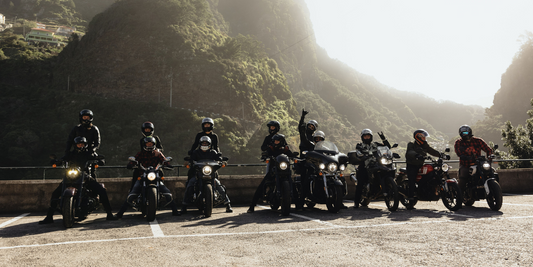
Two riders pull up at the same gas station. Same bike, same year, almost same engine. One's in a battered leather jacket with creases that have seen a thousand sunsets. The other's wearing a 3-layer textile with adjustable everything and a membrane you could probably swim in. They look at each other and silently agree: their setup is the right one.
Here's the thing – they're both right. Leather and textile do different jobs. The question is which job your week of riding actually demands.
Most arguments about leather versus textile I've heard at bike meets circle back to identity. Who you want to be on the bike. The actual riding stays out of the conversation. This article is an attempt to flip that order.
Why leather and textile motorcycle jackets work better for different riders?
The whole debate boils down to one question: what does your riding day actually look like? Someone who hammers canyon roads on weekends has very different needs from someone who commutes through city traffic five days a week and then heads out for a long weekend tour.
Leather has been around the longest. Cowhide leather, in particular, earned its place because of how the fibers behave when they meet asphalt at 80 km/h – they hold together, they slide cleanly, they survive heat that breaks softer materials down. That mechanical honesty is why race suits are still leather, decades after synthetic fabrics took over almost everything else in sportswear.
Textile evolved as a different answer to a different question. Riders started traveling further. Weather got messier. People wanted to ride in 5 °C drizzle in the morning and 28 °C sunshine by afternoon – in the same jacket. Modern textile builds combining stretchy outer shells with ripstop weaves deliver abrasion resistance that was barely possible 15 years ago, plus a level of climate flexibility that comes specifically from layered construction.
When you choose your motorcycle jacket material, you're really choosing how the jacket will behave under two pressures: abrasion energy on the slide, and weather over hours in the saddle. Everything else flows from there.
How riding speed, position, and route length change the best choice?
Speed matters more than people admit. The faster you go, the more energy your jacket has to dissipate if you ever come off. Sport riding – knee dragging, tucked behind the screen – punishes a jacket differently than upright touring. A low-side at 60 km/h is a completely different event from one at 160.
Riding position changes everything else too. A sport tuck stretches your back, opens your shoulders, and bunches the jacket at the lower spine. Leather, with its natural ability to mold to the rider over time, handles this beautifully. A textile cut for touring assumes an upright position – adjustable cuffs, expandable hip gussets, room for a thermal liner underneath.
Route length is the third variable. A 30-minute commute and a 6-hour highway run ask completely different things from your gear. Long routes mean changing weather and changing temperature, often across several hours where your energy and focus drift along with the conditions. Short city hops mean grab-it-and-go practicality, often layered over normal clothes.
What changes when you compare protection, comfort, and weather resistance?
Time to get into the actual numbers. Because "feels safer" is marketing. CE certification is reality.
When you flip a motorcycle jacket inside out, look for the EN 17092 label. That's the European standard that grades how the jacket performs in an abrasion test simulating a real slide. The scale runs A, AA, AAA – AAA being the highest. A solid baseline for any serious road jacket sits at AA at minimum. AAA appears on jackets built for maximum abrasion protection, whether that's a sport leather hammering canyon roads or a long-distance touring shell built for big mileage. That label tells you more about your actual safety than any marketing copy ever will.
Why leather is strong for abrasion protection and textile is easier to adapt to changing weather?
Leather's strength is mechanical. The fibers are dense, the surface tough, and when it slides it generates friction that bleeds off impact energy in a predictable way. Premium cowhide leather also resists tearing under shear stress – important when you catch a guardrail edge or a curb at speed. This is why sport jackets like the Rebelhorn Vandal 2 lean on leather for AAA-level protection.
Textile plays a different game. Modern textile motorcycle jackets use layered construction: an outer abrasion shell (Cordura, ballistic nylon, ripstop weaves), a waterproof membrane, and a thermal layer. Each layer does one job. Some designs go further with detachable, dual-position membranes – the HydraShield PRO in&out membrane on the Rebelhorn Hardy 3.0, for instance, can be worn inside the jacket for clean lines or outside as a shell when the weather turns mid-ride.
Then there's ventilation. Leather breathes through perforation – small holes punched in critical zones, often paired with ventilation channels along the sleeves and chest to keep airflow moving while keeping the slide surface intact. Textile lets designers go a lot further. A touring jacket can stack large front ventilation panels, sleeve channels, an openable rear panel, and a central torso channel. A summer street jacket like the Rebelhorn Jax takes this to the extreme – full 3D Matrix Mesh and steel mesh construction that basically turns the jacket into a wind tunnel you can wear.
Thermal flexibility is where textile really pulls ahead. A removable thermal liner – a separate vest you can wear under the jacket, on its own around camp, or stuff into a side bag – gives you one piece of gear that works across 25 degrees of temperature range. Last September I left Kraków at dawn in 4 °C fog and crossed into Italy by late afternoon at 24 °C with light rain. One jacket. Membrane in, then out, then thermal vest pulled, then membrane back in over the outer shell as a rain layer. That was the day I stopped arguing about whether textile counts as "real" motorcycle gear.
When a leather motorcycle jacket makes more sense than textile?
I bought a leather jacket in 2014. The first season it felt like wearing a board across the shoulders. By the third summer it had molded to me so completely that wearing anything else felt like cheating. That's something leather does that no spec sheet can communicate.
Reach for a leather motorcycle jacket when:
- Your riding is aggressive. Sport riding, track days, twisty mountain roads where you're hanging off the bike. Look for the highest abrasion rating you can get, Level 2 CE protection at shoulders, elbows, and back, and pockets for a chest protector. Replaceable external shoulder sliders are a nice bonus if you actually grind them down on track. The Vandal 2 sits firmly in this category – AAA certification, KEEP TECH RHOMB Level 2 protectors, perforated leather for airflow in critical zones.
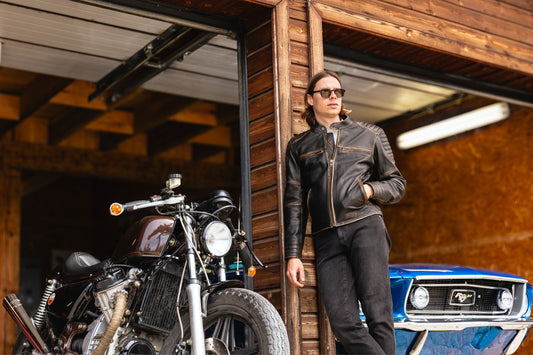
- You want a jacket that ages with you. Some jackets get better over the years. A single-layer leather jacket – goat leather for that vintage brown softness, cowhide for the deeper black – develops creases and a patina that nobody can replicate at the factory. The Rebelhorn Hunter II is a good reference here: pull the protectors out, throw it on with jeans, and it passes for normal civilian clothing.
- You want abrasion protection that does one thing extraordinarily well. Leather handles impact, abrasion, and tearing in one integrated material. There's something elegant about that simplicity.
The honest trade-off: leather is heavier, it absorbs water, and once soaked it takes a while to recover its shape. Care matters. A good leather jacket wants occasional conditioning. Treat it well and it'll outlast three textile jackets back-to-back.
When a textile motorcycle jacket is the smarter everyday option
Textile is what you reach for when conditions are unpredictable, distances are long, or you need one jacket that does fifteen jobs. It's the sport touring answer when one trip starts in fog and ends in sunshine 400 km away.
Here's the unpopular take: if your only motorcycle jacket is full mesh, you've already cast a vote on what your weather will do. Mesh assumes summer. Summer assumes you stay off the bike when the rain gets serious. Plan accordingly, or own a second jacket.
Reach for textile when:
- You ride year-round in changing weather. This is where 3-layer construction earns its keep. An abrasion-resistant outer, a waterproof membrane (bonus points if it's repositionable like the HydraShield PRO in&out on the Hardy 3.0), and a removable thermal liner that lets you tune the jacket from spring to autumn. Practical features carry weight here: magnetic ventilation flaps you can crack open at 130 km/h, Quick Dry pockets, a sleeve card pocket for tolls – the stuff that becomes important at 2 AM at a motorway gas station with gloves still on.
- You commute and adventure in the same week. A jacket that handles stop-and-go Tuesday traffic and a Saturday 600 km blast wants flexibility a single piece of leather struggles to deliver.
- You ride in hot urban environments. Summer city riding asks for serious airflow. Mesh panels – 3D Matrix Mesh, steel mesh, big perforated zones – pair well with a clip-out waterproof membrane so the jacket works on 32 °C scorchers and surprise rainy afternoons. The Jax is built around exactly this logic, with neoprene-finished cuffs and collar so the edges sit comfortable on long days.
- You want maximum adjustability. Sleeve circumference at forearm and bicep, waist adjustment, expandable hip gussets, adjustable back protector height – textile platforms let designers add more fit-tuning hardware than leather construction allows.
Textile keeps its clean technical look indefinitely. A leather jacket develops character over years of wear. Some riders love the clean tech aesthetic. Others want their jacket to look like it has a story. Personal call.
So which one are you?
The right jacket is the one you reach for without thinking on your worst-weather day. Pay attention to that reach.
If you ride hard and your forecast cooperates, leather. If your week is unpredictable and your routes are long, textile. If your honest answer is "I want both" – a leather like the Vandal 2 or Hunter II for weekends, a textile like Hardy 3.0 or Jax for everything else – that's two tools for two jobs. Both honestly priced. Both ready for the kind of riding that takes you off script.
Check the EN 17092 label before you swipe the card. Everything else is taste.